Hand Tools Market: By Type (Wrenches, Chisels, Hammers, Hand Saws, Axes, Pry Bars, Staple Guns, Hand Files, Vise, Scissors, C-Clamps, Crowbars, Hand Planer, Mallet, Screwdrivers, Pliers, Measurement Tape, and Anvils); Distribution Channel (Online and Offline); End User (Industrial, Professional, Residential/DIY, and others); Region—Market Size, Industry Dynamics, Opportunity Analysis and Forecast for 2026–2035
- Last Updated: 13-Jan-2026 | | Report ID: AA0822287
Market Snapshot
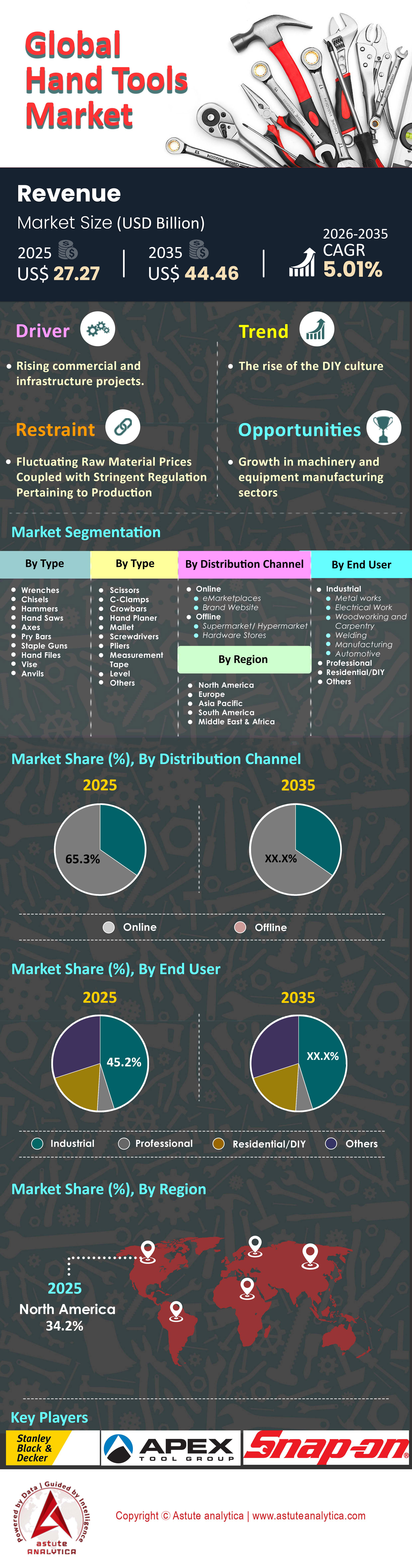
Hand tools market was valued at US$ 27.27 billion in 2025 and is predicted to reach US$ 44.46 billion by 2035, registering a CAGR of 5.01% during the forecast period 2026–2035.
Key Findings
- Based on type, the screwdriver segment has been able to account for 10% of the share in global market.
- When it comes to distribution, the offline segment captured a 65% share of the global hand tools market.
- By End User, industrial segment was the largest end user in the market accounting for 45%.
- North America maintains a leading position in the market.
Hand tools represent the fundamental currency of physical infrastructure. This category encompasses wrenches, pliers, screwdrivers, hammers, and specialized masonry equipment that operate without electrical power. While power tools often dominate headlines, the Hand tools market remains the backbone of the industrial world, offering reliability that batteries and cords cannot match. The market today is not driven by simple utility, but by a complex interplay of aging infrastructure, specialized labor demands, and global supply chain recalibrations.
What Are the Primary Engines Igniting Demand for Hand Tools?
The propulsion behind the hand tools market is currently twofold: a historic manufacturing construction boom and the unprecedented aging of mechanical assets. We are witnessing a "fixer-upper" economy. In the United States alone, the average age of light vehicles reached a record 12.6 years in 2024. This aging fleet, totaling 286 million vehicles in operation, forces consumers and professionals to engage in deeper, more frequent repairs, directly correlating with sales of socket sets and diagnostics tools.
Simultaneously, the built environment in the hand tools market is demanding massive tool volumes. The U.S. construction spending on manufacturing facilities surged to USD 236 billion by mid-2024, a staggering figure that necessitates industrial-grade fastening and cutting tools. This isn't just about new builds; residential activity remains a volume driver. With housing starts hitting 1.36 million units and single-family starts accelerating to a seasonally adjusted annual rate of 1.05 million units in December 2024, every new foundation poured and frame raised requires a fresh deployment of leveling and measuring tools.
To Get more Insights, Request A Free Sample
Which Applications Are Absorbing the Bulk of Hand Tools Market Volume?
Application demand in the hand tools market is sharply divided between the booming professional sector and a stabilizing DIY segment. The professional construction trades act as the primary volume absorber. With the U.S. construction industry employing 8.2 million workers in 2024, the replacement cycle for hammers, tape measures, and pliers is constant. Furthermore, the issuance of 1.47 million building permits last year signals that this application segment will continue to drain inventory well into 2025.
However, the automotive application is arguably the most value-dense for the hand tools market. The auto care industry, employing 887,000 technicians, relies on high-margin, precision alloy tools. Roughly 250,000 of these technicians hold ASE certifications, a demographic that drives demand for premium brands like Snap-on. On the consumer side, the application is driven by renovation intent. With the median home renovation spend clocking in at USD 24,000, and 52% of homeowners planning projects in 2024, the residential DIY application ensures a steady baseline of sales for mid-tier retailers.
Who Rules the Global Map in Production and Consumption?
The geography of the hand tools market is a story of East-West dependency. North America reigns as the consumption heavyweight. The financial scale is evident in retail performance; The Home Depot alone reported fiscal 2024 sales of USD 159.5 billion, moving massive volumes of hand tools to the American market. The U.S. imported USD 1.05 billion of specific hand tool categories from China in 2024, highlighting its reliance on foreign production to meet domestic demand.
Conversely, China remains the undisputed production powerhouse in the hand tools market. Supported by a massive crude steel output of 1 billion metric tons in 2024, Chinese manufacturers possess the raw material advantage necessary to dominate global exports. China exported USD 4.67 billion in hand tools globally last year. However, nuances are emerging. India is rising as a formidable alternative, having ramped up steel production to 150 million metric tons, while Germany maintains a grip on the ultra-premium segment, producing 37.2 million metric tons of high-grade steel to support European precision manufacturing.
What Recent Strategic Moves are Redefining the Competitive Board?
The hand tools market is seeing a strategic pivot from pure volume to operational efficiency and domestic expansion. Manufacturers are reacting to supply chain fragility by reshoring critical capabilities. A prime example is Klein Tools, which recently committed USD 32 million to a 200,000 square foot facility expansion in Texas, explicitly designed with heavy-duty crane bays to increase domestic output.
Concurrently, major conglomerates are slimming down to protect margins. Stanley Black & Decker successfully executed a program generating USD 500 million in cost savings in 2024, while drastically correcting inventory levels by over USD 2 billion. This leanness allows them to compete more aggressively on price. Sustainability is also reshaping operations; the same company reduced its carbon footprint by 54,800 metric tons CO2e, acknowledging that modern B2B contracts increasingly require green compliance.
What Is the Single Most Influential Trend Dominating Hand Tools Market?
In 2025, "Safety as a Specification" is the trend defining the Hand tools market. It is no longer just about the tool working; it is about the tool protecting the worker. This is driven by grim statistics: 395 fall-related fatalities in recent reports have pushed the industry toward "tethered" tools that cannot be dropped from heights. WernerCo responded to this urgency by conducting 500 safety training events in a single month, reaching 65,000 professionals.
Furthermore, the electrification of the automotive fleet is creating a specialized sub-market. With 3.2 million EVs now on the road, mechanics require insulated tools rated for high voltage to avoid electrocution. Major brands like Milwaukee Tool capitalized on this in their 2024 pipeline, launching over 100 new products with a heavy focus on these safety-compliant, insulated hand tools.
How Intense Is the Rivalry, and How Are Chinese Players Maneuvering?
The competitive landscape of the hand tools market is fiercely bifurcated. At the top, legacy giants defend their turf through immense brand equity and service networks. Snap-on, for instance, leverages its direct-to-mechanic van model to secure high margins, reporting USD 4.7 billion in 2024 sales with net earnings of USD 1.04 billion. Their ability to originate USD 301.7 million in financing in a single quarter creates a "lock-in" effect that low-cost competitors cannot easily break.
However, Chinese players are aggressively maneuvering up the value chain, moving beyond "cheap" tools to "value-engineered" solutions. They are also adept at navigating logistics. Despite freight rates spiking to USD 6,835 per FEU in mid-2024, Chinese exporters managed to keep flow consistent. Moreover, they are diversifying; China’s exports to Malaysia hit USD 233 million, using Southeast Asia as a transshipment and secondary manufacturing hub to bypass tariffs and trade barriers. This agility allows them to flood the Hand tools market with affordable options, forcing Western brands to rely on innovation and safety certification to justify their premium pricing. The rivalry in 2025 is no longer just about price; it is a battle between heritage reliability and agile, cost-effective availability.
Segmental Analysis
By Product Type, Safety Mandates and Multi-Functional Systems Drive Screwdriver Value Beyond Commoditization
While often viewed as basic commodities, the screwdriver segment maintains its 10% market share in the hand tools market by pivoting toward high-value, specialized applications that generic alternatives cannot address. Klein Tools’ "State of the Industry" data reveals that 76% of Millennial tradespeople now prefer multi-functional tools, driving a massive shift from single-use drivers to "system" tools like the 11-in-1 Impact Rated series. This evolution increases unit value significantly; a single specialized driver now commands a price point 3–4x higher than a standard fixed-blade tool.
Furthermore, the rapid expansion of the Electric Vehicle (EV) infrastructure has necessitated a surge in VDE-certified insulated screwdrivers in the hand tools market, which are non-negotiable for safety compliance. Milwaukee Tool’s "Pipeline 2024" event underscored this, announcing a 75+ hand tool expansion specifically targeting the electrical trades with high-leverage, insulated fastening solutions. Unlike the DIY market which has softened, professional demand for these safety-critical tools is inelastic. Wera Tools has further cemented this dominance by marketing ergonomic "Kraftform" handles to combat Repetitive Strain Injury (RSI), effectively positioning their screwdrivers as health-essential equipment for industrial workforces rather than simple hardware, thereby sustaining the segment’s revenue share.
By Distribution Channel, Immediate Availability and "High-Touch" Service Solidify Offline Distribution Dominance
The offline segment’s 65% share in the hand tools market is irrefutably anchored in the industrial requirement for immediacy and supply chain security. W.W. Grainger’s 2024 Annual Report provides the definitive proof: their "High-Touch Solutions" segment (North American offline/direct sales) generated $13.72 billion, accounting for over 81% of their total revenue, whereas their online-only "Endless Assortment" captured just $3.13 billion. This disparity exists because industrial buyers facing downtime cannot rely on shipping windows; they require the immediate inventory availability that physical branches and onsite services provide.
Fastenal further validates this "onsite" offline dominance in the hand tools market through its vending machine strategy. In their Q4 2024 earnings, Fastenal reported signing 27,984 new FASTBin and FASTVend devices, bringing their active onsite device count to approximately 127,000. These devices physically locate inventory inside customer facilities, effectively acting as micro-offline stores that guarantee immediate access. Additionally, Snap-on Incorporated’s 2024 10-K confirms the resilience of their 4,700-strong mobile franchise van network, which generates billions by physically driving tools to technicians. This "try-before-you-buy" model remains undisrupted by e-commerce because professionals demand tactile verification of tool balance and grip before making high-value investments.
Customize This Report + Validate with an Expert
Access only the sections you need—region-specific, company-level, or by use-case.
Includes a free consultation with a domain expert to help guide your decision.
By End Users, Infrastructure Investment and Critical Maintenance Shield Industrial Users From Volatility
The industrial segment’s 45.2% market leadership in the hand tools market is justified by a distinct decoupling from consumer economic trends. While The Home Depot reported in late 2024 that DIY discretionary spending had softened, their Pro segment (contractors and industrial) posted positive comparable sales, outperforming the consumer side. This resilience is driven by non-discretionary corporate capital expenditure in "critical industries" such as power generation, aviation, and fleet maintenance.
Snap-on’s Commercial & Industrial Group exemplifies this, reporting a 3.9% organic sales gain in Q4 2024, explicitly attributed to higher activity in the military and aerospace sectors. Unlike residential users who purchase tools for one-off projects, industrial users operate in high-wear environments requiring frequent replacement of premium, safety-regulated tools. Grainger’s financial data further supports this, showing that their High-Touch industrial segment delivered a superior 18.9% operating margin compared to other channels. This indicates that industrial end-users are not only buying more volume but are less price-sensitive regarding mission-critical equipment (like non-sparking or tethered tools) required for regulatory compliance, thereby securing the segment's financial dominance.
To Understand More About this Research: Request A Free Sample
Regional Analysis
North America Market Leadership Fueled by Construction Boom and Aging Vehicle Fleets
North America continues to command the dominant share of the global hand tools market, primarily driven by an aggressive resurgence in U.S. residential and industrial activity. The region’s strength is underpinned by the completion of 1.36 million housing units in 2024, which has created a massive, sustained requirement for carpentry and framing tools. Beyond residential zoning, the region is experiencing a manufacturing renaissance; construction spending on new factories skyrocketed to USD 236 billion by mid-2024. This wave of industrialization supports a workforce of 8.2 million construction professionals who constantly replenish heavy-duty tool inventories.
Furthermore, the automotive aftermarket provides a recession-proof revenue stream. With the average vehicle age hitting a record 12.6 years, North American consumers are forced to invest heavily in repair and maintenance tools to keep older fleets operational.
Asia Pacific Manufacturing Scale and Infrastructure Projects Secure Second Largest Market Position
Following North America, the Asia Pacific region holds the second-largest market share of the hand tools market, functioning as both the world’s manufacturing engine and a growing consumption hub. The region’s dominance is anchored by China, which exported USD 4.67 billion worth of hand tools in 2024, supplying both internal infrastructure projects and global partners. This manufacturing supremacy is supported by immense raw material availability, with China producing 1 billion metric tons of crude steel in 2024.
However, the region is not reliant on a single player; India is emerging as a critical growth vector, having ramped up its own production to 150 million metric tons of steel to support local urbanization. Regional trade dynamics are also evolving, evidenced by China directing USD 233 million in tool exports specifically to Malaysia, signaling a deepening intra-regional supply chain that bolsters market resilience.
Europe Hand Tools Market is Driven by Precision Manufacturing and Industrial Retrofit Projects
Europe maintains its stronghold as the third-largest region, characterized by a focus on high-precision engineering and industrial retrofitting rather than sheer volume construction. The market here is stabilized by Germany’s industrial output, which contributed 37.2 million metric tons of crude steel in 2024, ensuring a steady supply of high-grade alloy for premium tool production. However, the region has faced significant logistical headwinds that have shaped pricing strategies.
European distributors had to navigate a peak freight rate of USD 5,270 per FEU on the Shanghai-to-Rotterdam route in mid-2024, which temporarily inflated landed costs for imported inventory. Fortunately, cost pressures eased as the global freight index moderated to USD 3,349 later in the year, allowing European markets to stabilize inventory levels for professional tradespeople focused on renovation and energy-efficiency retrofits.
Top 5 Recent Developments in Hand Tools Market
- Bosch Limited launched a new hand tools range in March 2025, featuring over 100 products like pliers, screwdrivers, ratchets, wrenches, hammers, saws, knives, and spirit levels for professionals and artisans, emphasizing ergonomics and durability.
- toolant announced its new hand tools collection in August 2025 via GlobeNewswire press release, introducing the 10-inch Plier Wrench and ⅜'' Drive Flex Head Ratchet Wrench for automotive enthusiasts and detailers, targeting everyday to extreme use.
- Sonic Group acquired Sonic Tools USA in January 2025, as per their PRNewswire release, to expand premium hand tools, storage, and solutions in North America for automotive, aviation, and manufacturing sectors, enhancing distributor networks.
- Wiha Tools introduced 14 innovative new products in September 2025, including GoStack modular storage boxes and new impact socket sets, as detailed on their official site, broadening their professional hand tools lineup.
- Stanley Black & Decker highlighted 2025 Pro Tool Innovation Award winners in September via their site, recognizing advances in hand tools like cordless screwdrivers within their tools portfolio for professional users.
Top Companies in the Hand Tools Market
- Akar Tools Limited
- Apex Tool Group
- Channellock, Inc.
- Emil Lux GmbH & Co. KG
- Fluke Corporation
- Gedore GmbH
- JCBL India
- Klein Tools
- KNIPEX Group
- KS Tools Werkzeuge and Maschinen GmbH
- Milwaukee Tool Corporation
- MISUMI Group Inc
- Robert Bosch GmbH
- Sathlwille Tools
- Snap-on-Incorporated
- Stanley Black and Decker
- Taparia Tools
- Techtronic Industries Co. Ltd.
- Weidmuller Interface GmbH and Co. KG
- Wera Tools
- Emerson Electric Co.
- Other Prominent Players
Market Segmentation Overview:
By Type
- Wrenches
- Chisels
- Hammers
- Hand Saws
- Axes
- Pry Bars
- Staple Guns
- Hand Files
- Vise
- Anvils
- Scissors
- C-Clamps
- Crowbars
- Hand Planer
- Mallet
- Screwdrivers
- Pliers
- Measurement Tape
- Level
- Others
By Distribution Channel
- Online
- eMarketplaces
- Brand Website
- Offline
- Supermarket/ Hypermarket
- Hardware Stores
By End User
- Industrial
- Metalworks
- Electrical
- Woodworking and Carpentry
- Welding
- Manufacturing
- Automotive
- Professional
- Residential/DIY
- Others
By Region
- North America
- The U.S.
- Canada
- Mexico
- Europe
- The UK
- Germany
- France
- Italy
- Spain
- Poland
- Russia
- Asia Pacific
- China
- Taiwan
- India
- Japan
- Australia & New Zealand
- ASEAN
- Rest of Asia Pacific
- Middle East & Africa (MEA)
- UAE
- Saudi Arabia
- South Africa
- Rest of MEA
- South America
- Brazil
- Argentina
- Rest of South America
REPORT SCOPE
| Report Attribute | Details |
|---|---|
| Market Size Value in 2025 | US$ 27.27 Billion |
| Expected Revenue in 2033 | US$ 44.46 Billion |
| Historic Data | 2020-2024 |
| Base Year | 2025 |
| Forecast Period | 2026-2035 |
| Unit | Value (USD Bn) |
| CAGR | 5.01% |
| Segments covered | By Type, By Distribution, By End-User, By Region |
| Key Companies | Stanley Black and Decker, Robert Bosch GmbH, MISUMI Group Inc, Milwaukee Tool Corporation, Snap-On Inc, Klein Tools, Fluke Corporation, KNIPEX Group, Weidmuller Interface GmbH and Co. KG, Emil Lux GmbH & Co. KG, Sathlwille Tools, Gedore GmbH, KS Tools Werkzeuge and Maschinen GmbH, Taparia Tools, Akar Tools Limited, Techtronic Industries Co. Ltd., Wera Tools, Apex Tool Group, Channellock, Inc., JCBL India, Emerson Electric Co., Other Prominent Players |
| Customization Scope | Get your customized report as per your preference. Ask for customization |
FREQUENTLY ASKED QUESTIONS
The market was valued at USD 27.27 billion in 2025. It is projected to ascend to USD 44.46 billion by 2035, registering a steady CAGR of 5.01% throughout the forecast period of 2026–2035.
Growth is driven by a fixer-upper economy, specifically the record-high average vehicle age of 12.6 years in the U.S., which necessitates frequent repairs. Simultaneously, a manufacturing construction boom, with spending reaching USD 236 billion, is increasing the requirement for industrial-grade fastening and cutting tools.
Safety as a Specification has become the dominant trend following reports of 395 fall-related fatalities. This has triggered a massive shift toward tethered tools for height safety and VDE-certified insulated tools to service the rising fleet of 3.2 million EVs.
Offline channels retain dominance in the hand tools market because industrial buyers prioritize immediate availability to minimize downtime. High-touch models, such as Snap-on’s mobile vans and Fastenal’s onsite vending machines, provide the tactile verification and instant access that online platforms cannot replicate for mission-critical equipment.
North America leads the market, underpinned by 1.36 million housing starts and a workforce of 8.2 million construction professionals. This region combines high-volume residential demand with heavy industrial procurement, creating a sustained consumption cycle.
Key players are pivoting toward domestic resilience. For example, Klein Tools invested USD 32 million to expand U.S. production capacity. Concurrently, giants like Stanley Black & Decker focused on operational leanness, generating USD 500 million in cost savings to remain competitive against agile global exporters.
LOOKING FOR COMPREHENSIVE MARKET KNOWLEDGE? ENGAGE OUR EXPERT SPECIALISTS.
SPEAK TO AN ANALYST
.svg)

 Schedule a Meeting

Features | Type of License | ||||
 Data Book | Single User |   Multi User |  Corporate | ||
| e-Access | ✓ | ✓ | ✓ | ✓ | |
User Sharing | 1 User Only | 1 User Only | Up to 7 Users | Unlimited User Access | |
⨉ | ⨉ | ⨉ | ✓ | ||
Free Customization | No Free Customization | Up To 30 hrs work | Up To 60 hrs work | Up To 80 hrs work | |
Deliverable |
| ⨉ | ✓ | ✓ | ✓ |
| ✓ | ⨉ | ✓ | ✓ | |
| ⨉ | ⨉ | ⨉ | ✓ | |
Analyst Support | 2-Months Analyst Support | 4-Months Analyst Support | 7-Months Analyst Support | One Year Analyst Support | |
Free Report update in next update cycle | ⨉ | ⨉ | ⨉ | ✓ | |
Free Industry Update (Within 180 days) | ⨉ | ⨉ | ⨉ | ✓ | |
Benefit | Up to 10% off on Post Purchase | Up to 20% off on Post Purchase | Up to 30% off on Post Purchase | Up to 40% off on Post Purchase | |